What Is the Great Wildebeest Migration?
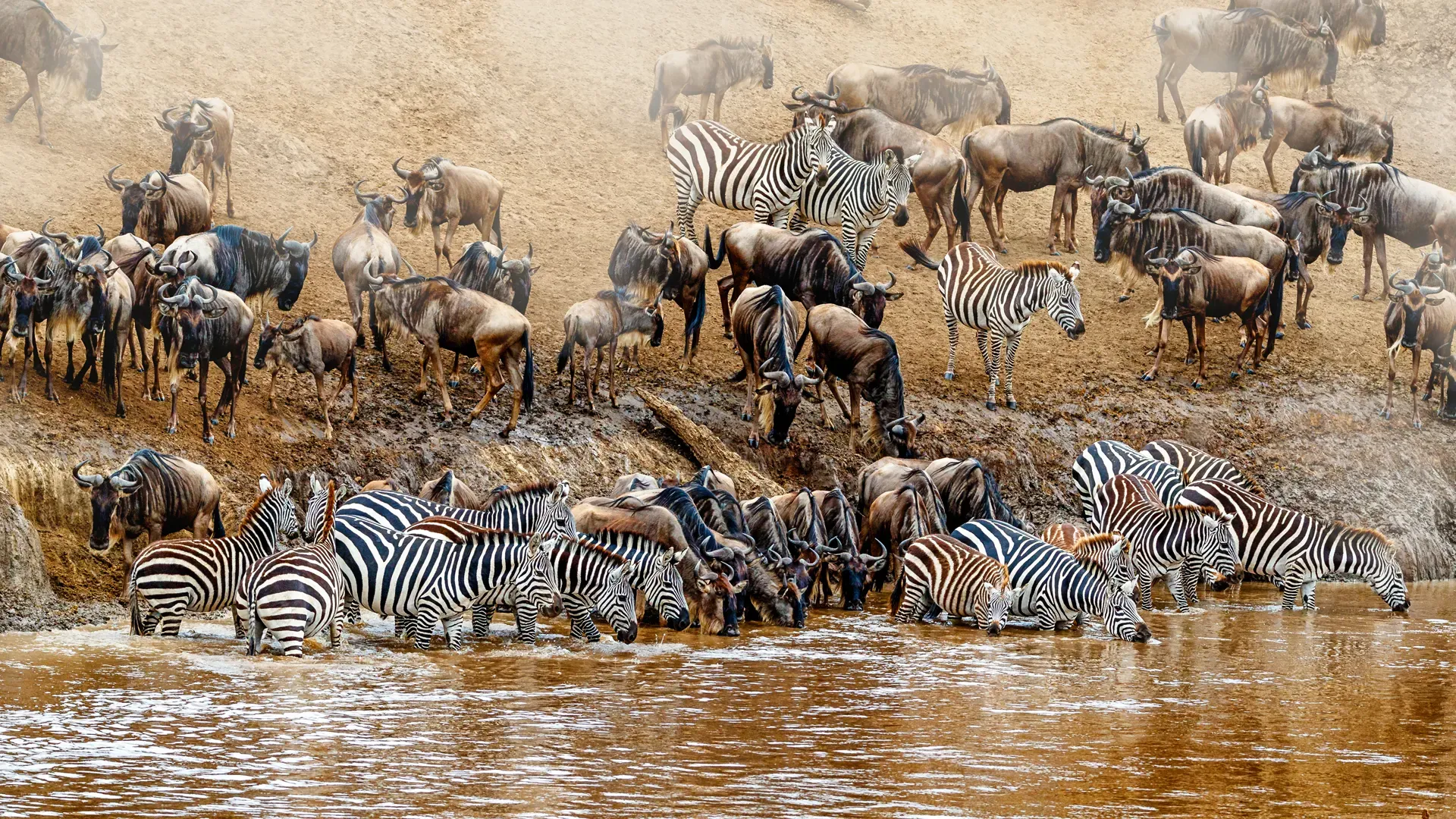
The Great Wildebeest Migration is not a single event — it is a continuous, year-round cycle driven by one simple instinct: the search for fresh grass and water. Over 1.5 million wildebeest, joined by roughly 500,000 zebras and 200,000 Thomson's gazelles, move in a vast clockwise loop across the Serengeti plains of Tanzania and the Maasai Mara in Kenya, following the rains and the green pastures they bring.
The wildebeest don't have a leader. There is no single animal directing the herd. Instead, the movement is governed entirely by nature — rainfall patterns, grass growth, and an ancient, hardwired instinct that has been repeating itself for millennia. That is what makes it so humbling to witness. You are watching evolution in real time.
The Migration Calendar: Month by Month
Understanding the migration requires understanding its rhythm. Here is what happens throughout the year:
January to March — Calving Season in the Southern Serengeti
The herds spend the early months of the year in the short-grass plains of the southern Serengeti and the Ndutu area in Tanzania. This is calving season — approximately 500,000 calves are born in a concentrated period of just a few weeks. The plains are alive with newborns taking their first wobbly steps, often within minutes of birth. This draws an extraordinary concentration of predators — lions, cheetahs, leopards, hyenas, and wild dogs — making this one of the most dramatic wildlife viewing periods of the entire year.
April to May — The Long Rains and the Move North
As the rains arrive and the southern grass is depleted, the herds begin their long march northward through the central Serengeti. This is a quieter period for tourism, but the landscape is lush, green, and extraordinarily beautiful, and the sheer spectacle of hundreds of thousands of animals on the move is something to behold.
June — Reaching the Western Corridor and the Grumeti River
By June, the leading herds have reached the western corridor of the Serengeti and must cross the Grumeti River — home to massive Nile crocodiles that have been waiting all year for this moment. These crossings are smaller and less famous than the Mara River crossings further north, but they are no less dramatic.
July to October — The Mara River Crossings
This is the moment that defines the migration in the global imagination. By July, the herds begin arriving in the Maasai Mara in Kenya, and the famous Mara River crossings begin. The wildebeest mass on the riverbanks in their thousands, driven by the urge to cross but terrified by the churning water and the enormous Nile crocodiles lurking below. The tension builds — sometimes for hours — until a brave few plunge in and the rest follow in a thundering, chaotic torrent of hooves and bodies.
Crocodiles strike. Wildebeest are swept away by the current. Some make it across, some don't. The drama plays out multiple times a day at different crossing points. It is one of the most intense wildlife spectacles that exists anywhere on earth.
November to December — The Return South
By late October and November, the short rains arrive in Tanzania and the herds begin their return journey south, completing the cycle. The Mara gradually empties as the wildebeest pour back across the river and head toward the Serengeti to begin again.
Where to Watch the Migration in Kenya
The Maasai Mara National Reserve is where the Kenyan leg of the migration takes place, and it offers some of the most accessible and dramatic migration viewing on the continent. The key areas include:
The Mara River — This is ground zero for the crossings. The river stretches for kilometres through the reserve, and there are numerous established crossing points. Game drivers and guides monitor the herds constantly to position you at the right spot when a crossing is imminent. Patience is essential — crossings cannot be predicted to the hour — but the wait is always worth it.
The Mara Triangle — The western section of the Mara, managed by the Mara Conservancy, is less crowded than the main reserve and offers excellent migration viewing, particularly for the early arrivals in July and the herds that linger into October.
The Private Conservancies — Surrounding the main reserve are several private conservancies — Olare Motorogi, Naboisho, Ol Kinyei, Mara North — that offer exclusive migration viewing with fewer vehicles, more personalised guiding, and the ability to do night drives and walking safaris that are not permitted in the main reserve.
How to Make the Most of Your Migration Safari
Go with an expert guide. The difference between a migration safari with a knowledgeable, experienced guide and one without is enormous. An expert guide understands animal behaviour, knows the crossing points, reads the herd's movements, and positions you perfectly. At Pin Holidays & Safaris, all our migration safaris are led by the finest guides in the Mara.
Stay as long as possible. A minimum of three nights in the Mara is recommended during migration season, with four to five nights being ideal. Crossings happen unpredictably — sometimes multiple times a day, sometimes not for days. The longer you stay, the better your chances.
Choose your accommodation wisely. Where you stay in the Mara matters enormously. Camps right on the river or within the conservancies give you the fastest access to crossing points and the most immersive experience.
Book early. July to October in the Maasai Mara is the most in-demand period of the safari calendar globally. Premium camps and lodges sell out a year or more in advance. Do not leave your migration safari to chance.
Quick Facts
The migration covers approximately 1,800 kilometres in its annual loop. Around 250,000 wildebeest perish each year to predators, exhaustion, drowning, and hunger — their bodies sustaining the entire ecosystem. The Mara River crossings can happen anywhere along a stretch of several kilometres, which is why having the right guide is so critical. No two crossings are ever the same.
Experience the Great Migration with Pin Holidays & Safaris
The Great Wildebeest Migration is a bucket-list experience that deserves to be done properly. At Pin Holidays & Safaris, we have been placing travellers in front of this spectacle in the best possible way — the right camps, the right guides, the right timing, and the right level of personal care that ensures your migration safari exceeds every expectation.
We handle everything — flights, airport transfers, accommodation, park fees, game drives, and all the details in between — so that all you have to do is show up and be amazed. Whether you're planning a solo adventure, a romantic getaway, a family trip, or a group expedition, we have a migration package tailored precisely to you.
Don't just watch it on a documentary. Come and feel the ground shake.
Visit pinsafaris.com to explore our migration packages or contact our team to start planning your journey today.